Elise’s journey began with a childhood love of books and grew through a life filled with letters, color, and imagination. Her art blends words and visuals, encouraging viewers to pause, observe, and discover their own interpretations. In this interview, she shares her path, her pauses, and how she found her way back to painting.
Can you tell us a little about yourself and how you got into art?
I’ve loved reading ever since I was a child. I was fascinated by how a row of small symbols could contain entire worlds. I devoured books, drew constantly, and was always making things. When my parents were hesitant about art school, I chose a practical route first: a graphic design education. It turned out to be a perfect bridge between my love of letters and my urge to create visual worlds.
After finishing my design studies, I attended art school and started my own graphic design studio to support myself. While building my career as a designer, I tried to step into the art world, but when my first child was born, combining everything became difficult. My design work was thriving, so I put my artistic ambitions on hold, promising myself I would return to painting later.
When my children grew older, I realized I couldn’t postpone that dream until retirement. I created business cards, a website, and a portfolio, ready to approach galleries and exhibition spaces. Then the pandemic hit, and plans changed again. Social media, especially Instagram, became my new platform. Unexpected opportunities arose: I was invited to submit work for an exhibition in India, and Margin Alexander, who is a composer in New York City, used my paintings as inspiration for a musical composition, projecting my work during performances. The pandemic gave me time to develop my style and create a strong body of work, laying the foundation for the next phase of my artistic practice.
How did working in graphic design shape the way you create your paintings today?
My background in graphic design has definitely shaped how I work. Graphic design taught me precision planning ahead, sketching, and knowing exactly how a project will turn out. Painting, for me, begins at the opposite end. I start with intuitive, rough gestures, allowing shapes and forms to emerge spontaneously on the canvas. I don’t sketch; I follow what unfolds.
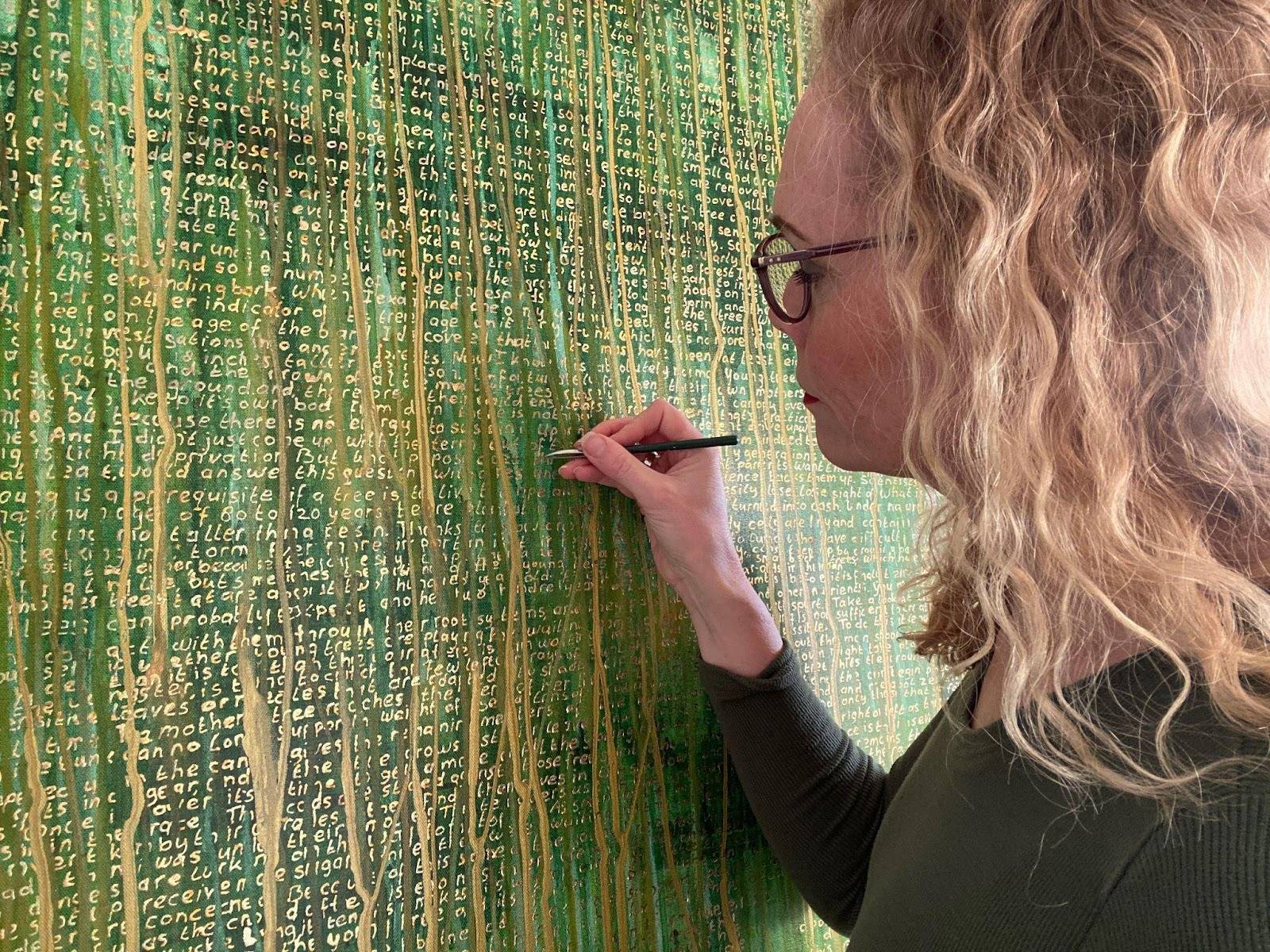
As the painting develops, precision returns. Texts are placed carefully, in the right color and the right position. I add, remove, or paint over elements until everything feels balanced. In the end, my paintings are a blend of both worlds: intuitive freedom and graphic precision, connected through my ongoing fascination with combining text and image.
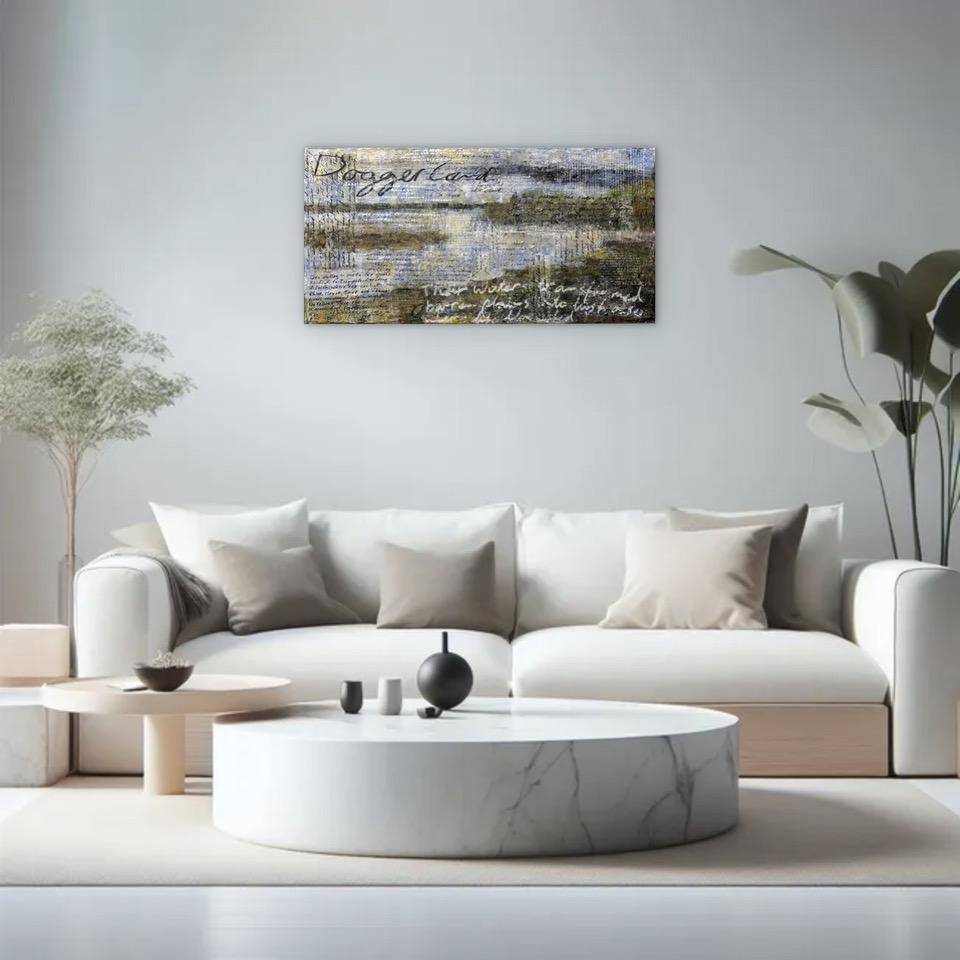
Letters play a big role in your work. What do you love most about them?
Letters have always felt magical to me. They are beautifully shaped symbols and, at the same time, gateways. Once you know how to read, letters are never just letters again.
When we read, the forms fade and something else begins: worlds unfold, emotions surface, and imaginary landscapes appear.
Text allows us to travel through time, into other lives, and into experiences we could never have imagined on our own. What moves me most is that these worlds do not exist until someone reads them and that they are different every time.
The same words create entirely different universes in different minds. That tension between visibility and meaning, between form and imagination, lies at the core of my work.
Your pieces change depending on light and perspective. How do you decide what to include?
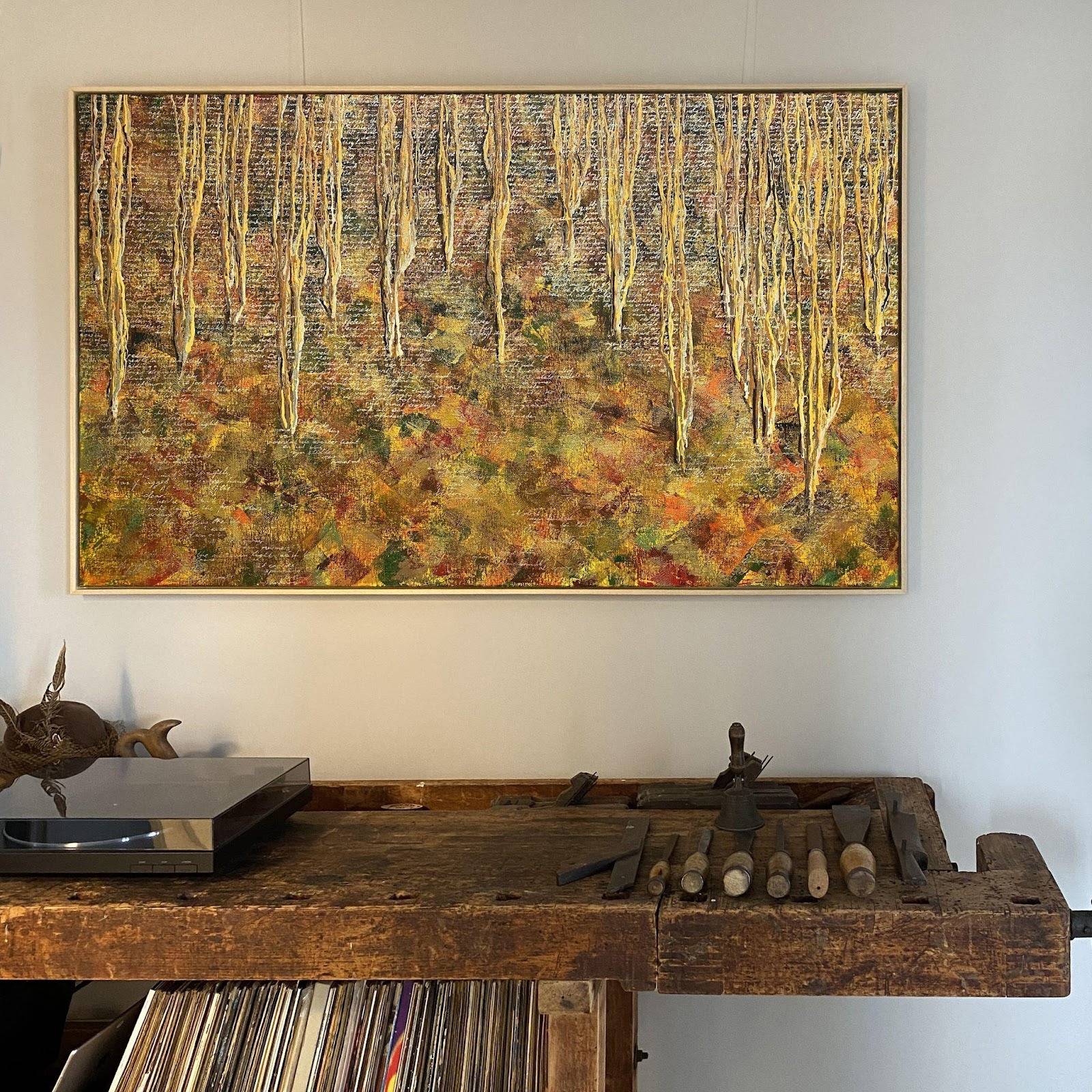
What appears in my paintings develops organically. I often start with ideas inspired by texts I’ve read, and from there images, colors, and forms emerge intuitively. Text and image are deeply intertwined: letters shape the image, and the image reveals the text. Sometimes the words are clearly visible; sometimes they remain subtle, fading in and out depending on the light and the viewer’s position.
I frequently work with metal leaf, similar to gold leaf ultra-thin sheets that adhere only to areas treated with adhesive. Because the metal reflects light, the text may suddenly stand out or almost vanish. As daylight shifts or the viewer moves, the painting changes, giving it a sense of motion and life.
Are there personal experiences that inspire your art?
Very much so. Childhood books have inspired entire paintings, and reading those same stories to my own children completes a full circle. Once, I made a large, colorful flower painting inspired by Paul Biegel’s Big en Growt, but my son who is colorblind called it “the most boring painting ever.” I invited him to choose the colors himself, replacing oranges and yellows with bright blues and pinks. Suddenly, the painting came alive for him.
I also like to incorporate my own writing diary fragments, poems, or short texts — adding a personal layer that connects directly to the work.
When you start a new painting, do you follow a plan or just go with the flow?
It’s a combination of both. I usually begin with a color palette and a base layer. From there, I might let forms emerge freely, or I may research a specific subject beforehand. Text is often added at a later stage, although recently I’ve been experimenting with screen-printed lettering early in the process, which creates a very different dynamic.
Do certain landscapes or natural elements often inspire your work?
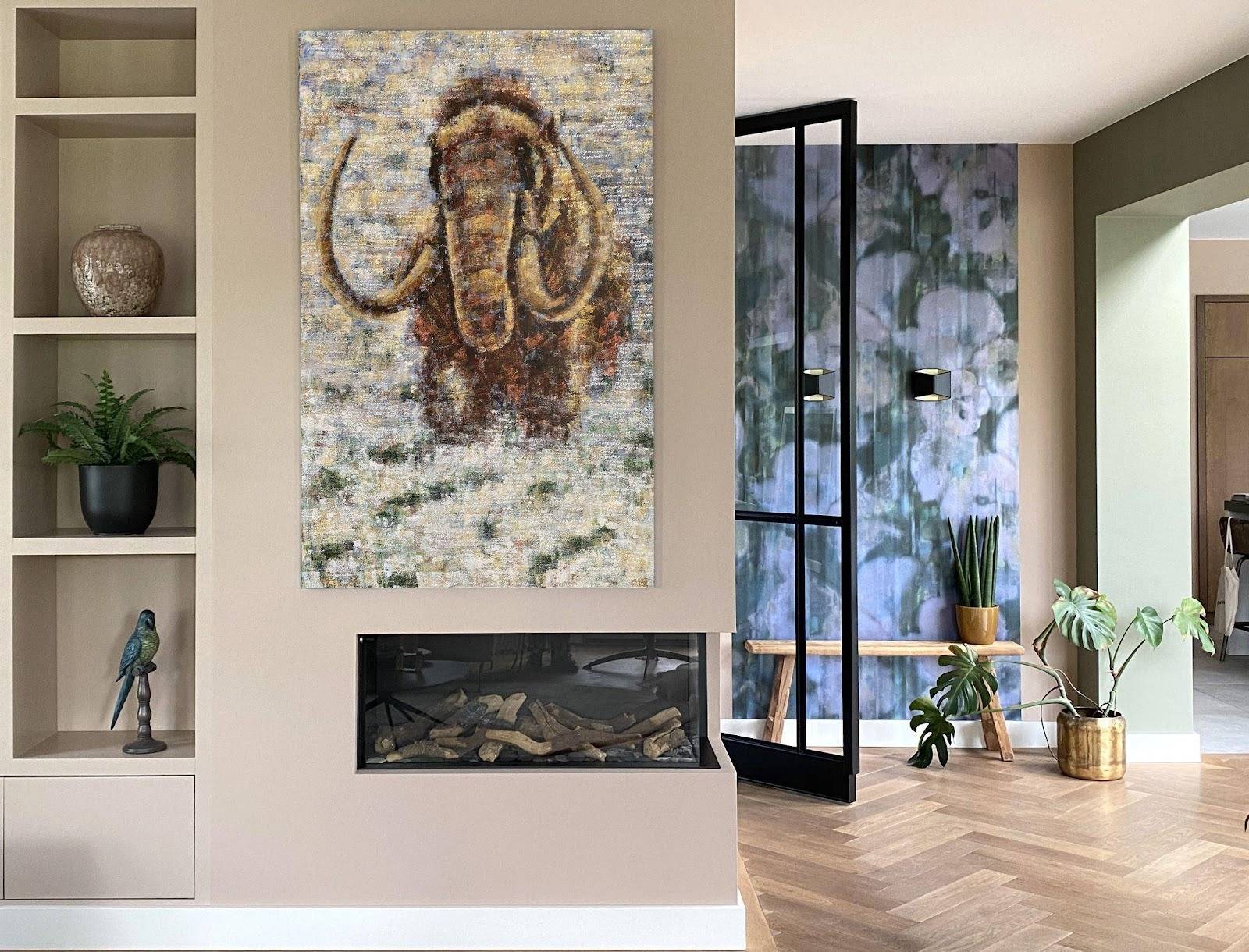
I’ve worked with many themes over the years. Some series feel complete, while others keep evolving. One way or another, I always return to forests and abstract landscapes. Alien-like woods, autumn forests, prehistoric landscapes now hidden beneath the North Sea, Dutch polders, and seascapes, sometimes abstract, sometimes figurative.
I don’t try to resist this pull; I let it guide me. Descriptions of nature spark my imagination the most. Environments help shape stories, allowing the viewer to travel through imagined worlds. Recently, I’ve been especially fascinated by Doggerland — the lost land beneath the North Sea, once home to mammoths, Neanderthals, and powerful rivers.
How do you hope people feel when they notice hidden layers or text in your paintings?
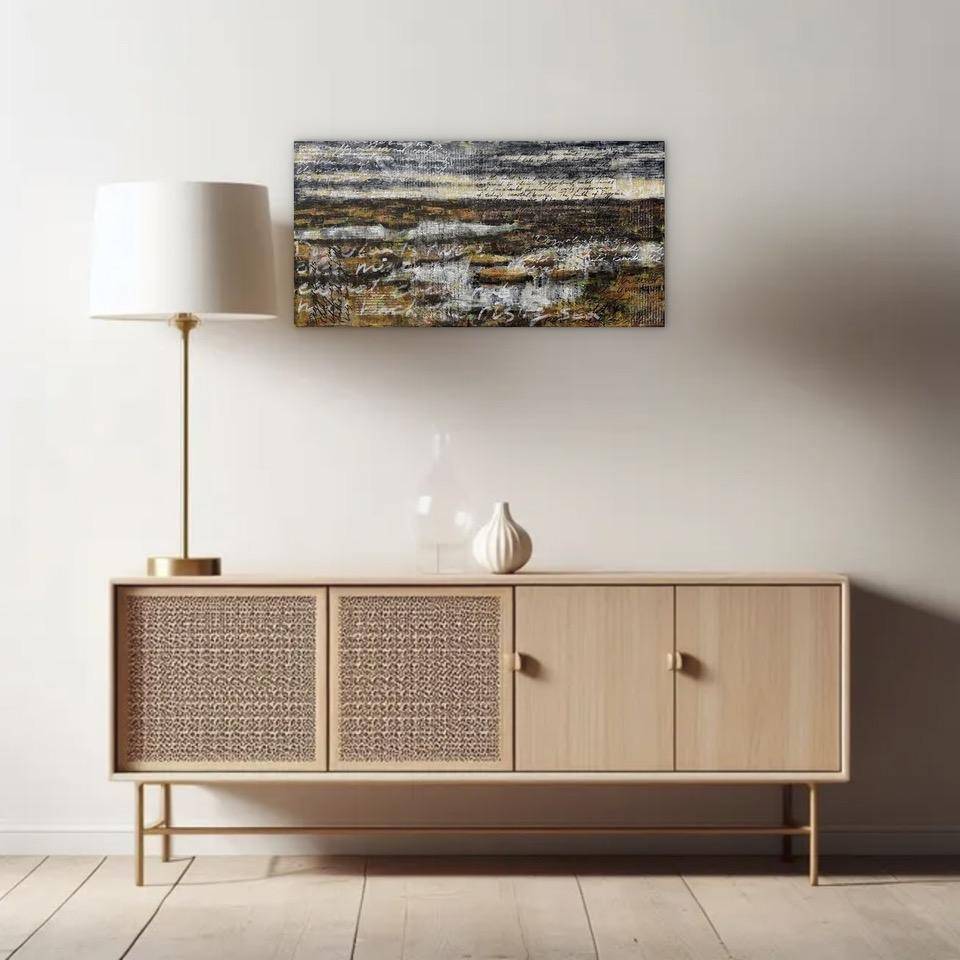
I hope my work invites reflection and imagination. Even when a painting contains large blocks of text, it’s not meant to be read like a book. Viewers often notice fragments or single words, and the associations those words trigger differ from person to person. I hope people feel free to create their own stories and interpretations and perhaps even start conversations about what they see and feel.
Can you share a project that was tricky or challenging and how you handled it?
I once worked on a large painting (150 × 200 cm) using modeling paste. Halfway through, I realized I had accidentally used a type intended for hard surfaces. It wasn’t flexible enough for canvas and would have cracked over time. I had to remove everything and start again. It was painful both in time and materials but it taught me an important lesson. Since then, I always double check my materials before I begin.
Have you ever been surprised by how someone reacted to your work?
Absolutely. I often notice how differently people perceive my work. In a series featuring snowy owls, some viewers don’t see the owl at all at first. They think the painting is fully abstract until they suddenly “discover” it and excitedly point it out. It reminds me how personal perception really is.
I intentionally position my work on the border between abstract and figurative. Once, a woman saw a painting of a young girl and recognized her granddaughter, who had passed away at birth. She imagined her grown into a joyful young woman and bought the painting to keep that image close. Experiences like that are deeply moving and humbling.
Do you have any daily habits or routines that help you stay creative?
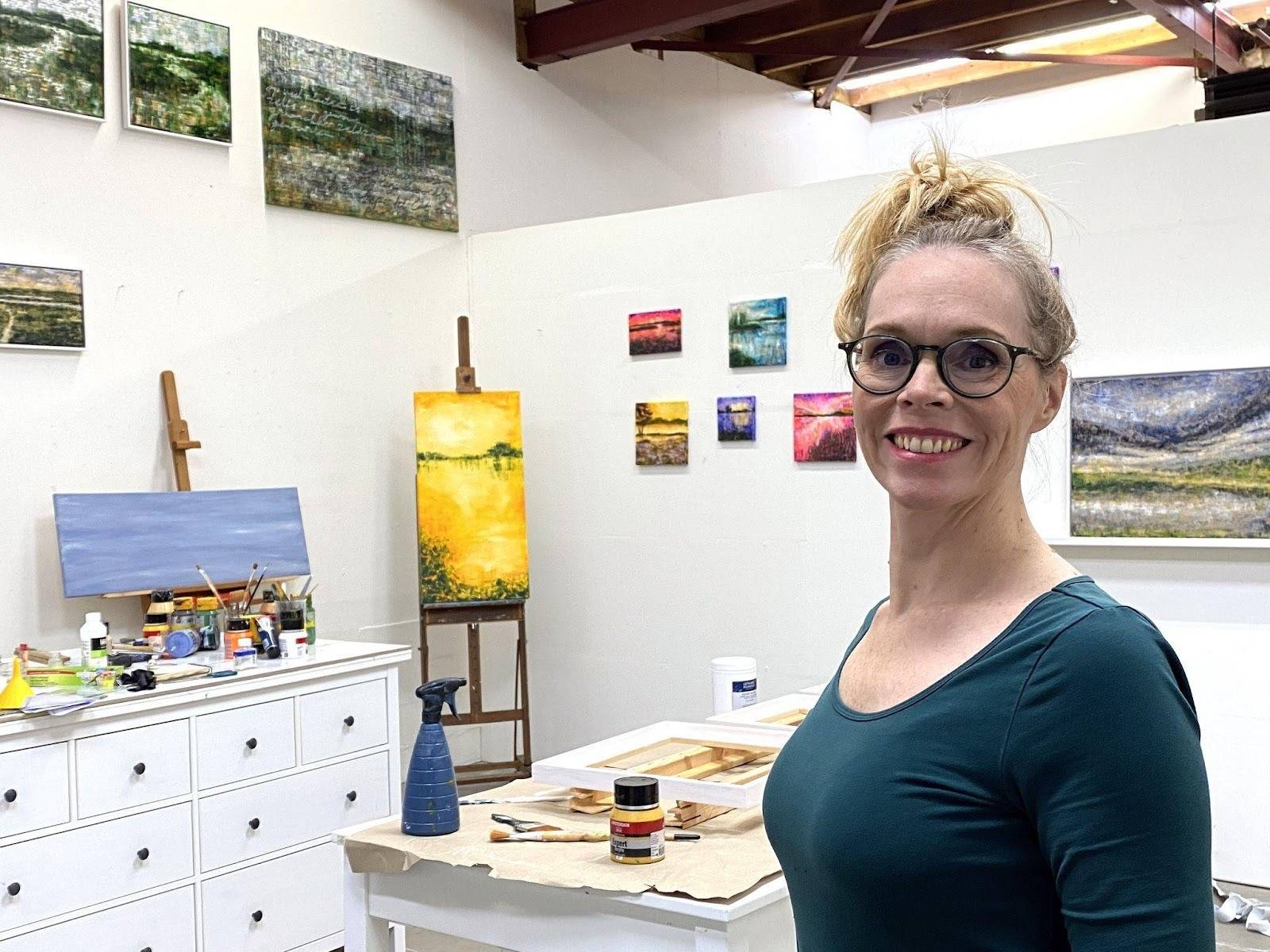
My studio is outside my home, and simply being there immediately shifts me into a creative mindset. It’s a place where everyday concerns fall away. When I feel stuck, I might tidy up, stretch new canvases, or begin another painting. Having space to work on multiple pieces at the same time and leave them unfinished gives me freedom and keeps my creativity flowing.
What new ideas or themes are you excited to explore next in your art?
I’m currently exploring what happens when I add more: large and small texts, stencils, screen printing, collage, increasing layers and density. At the same time, I’m curious about the opposite: removing elements, working with fewer layers, minimal or no text, and no metallic foil. It’s an ongoing artistic journey, and I don’t yet know where it will lead which is exactly what excites me.