

She paints what many of us are taught to hide – the body, intimacy, ageing, death and everything in between.
In this conversation, we explore the ideas, experiences and emotions behind her work, and what it means to find beauty in some of life’s most intimate and challenging subjects.
“My mission is to reveal the aesthetic and emotional beauty of our intimate relationships with one another.”
Your paintings touch on a plethora of very human realities, ranging from bodily functions like menstruation and lactation to sexuality and death. Have you always gravitated towards these kinds of subjects?
When I look back at my early work, it was mostly academic and ordinary subject matter, still lifes, portraits, etc. However, I recall a birthday card I made for my mother, probably in high school, in which she is giving birth to a very large egg containing a fully formed woman (me). It was an early rendering of bodily and reproductive subject matter.
My first painting after nursing school, and after a long break from art, portrays a woman with a book in her lap, distracted from studying by thoughts of her lover. An ocean of water pours from her yoni (the Sanskrit word for vulva). However, a friend interpreted the image as the breaking of water in pregnancy, heralding the start of labor.
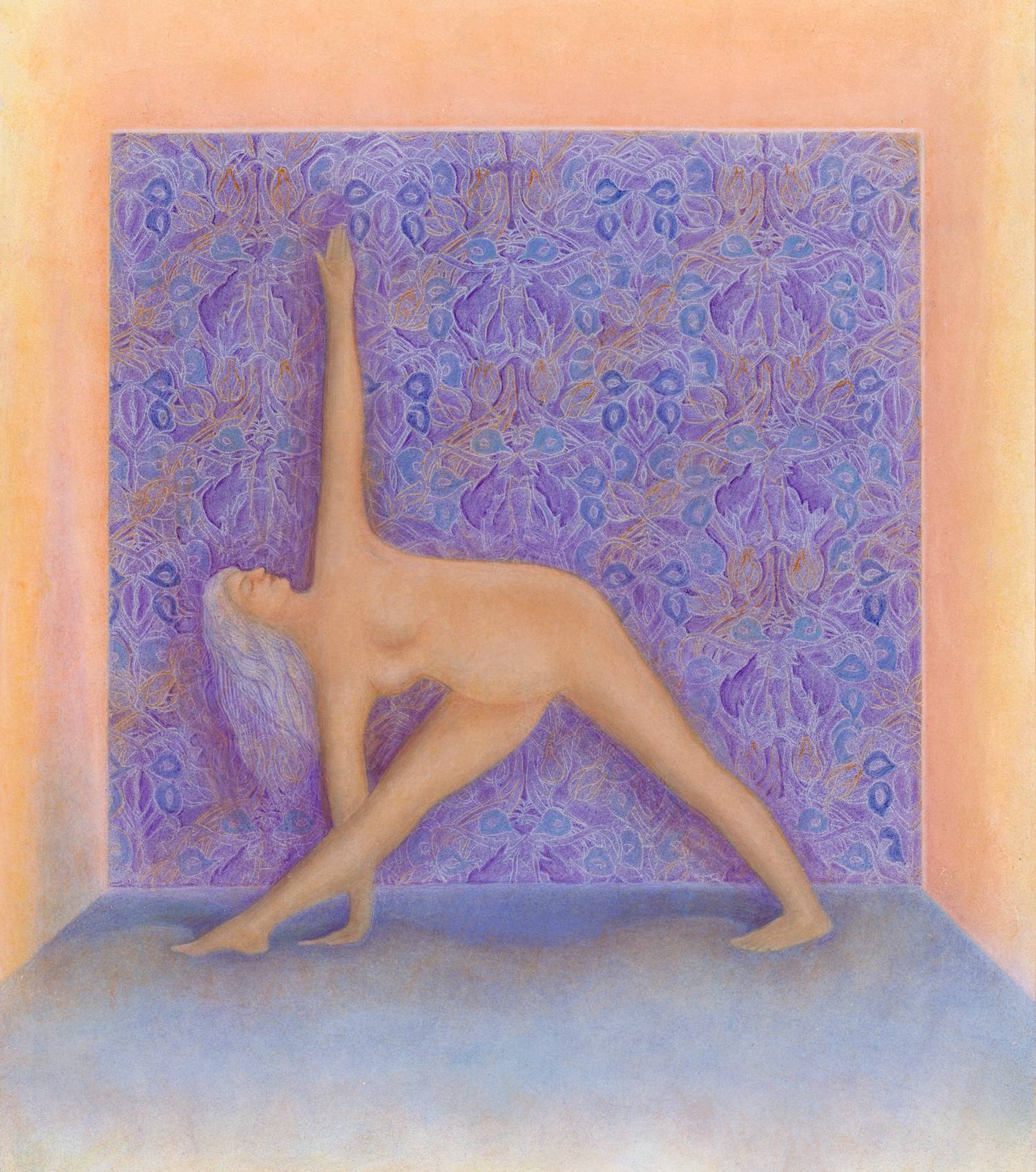
Aside from portraiture, an abiding practice, I believe most of my paintings contain “challenging” subjects, except for one period in which I purposefully made paintings of yoga poses. But even that became controversial as I painted the bodies nude so as not to interrupt the flow of the figure’s lines. I even had some yoga studios advise me to put gym shorts on the figures!
How do you navigate depicting what you’ve described as “uncensored” subject matter without it becoming explicit in a way that detracts from the art?
This is perhaps one of my biggest challenges. My mother once said, “I like your pornography.” However, an erotic art dealer said my art was non-pornographic on the grounds that it is “non-titillating.” It’s true that I’m not after titillation or sexual arousal; rather, my mission is to reveal the aesthetic and emotional beauty of our intimate relationships with one another.
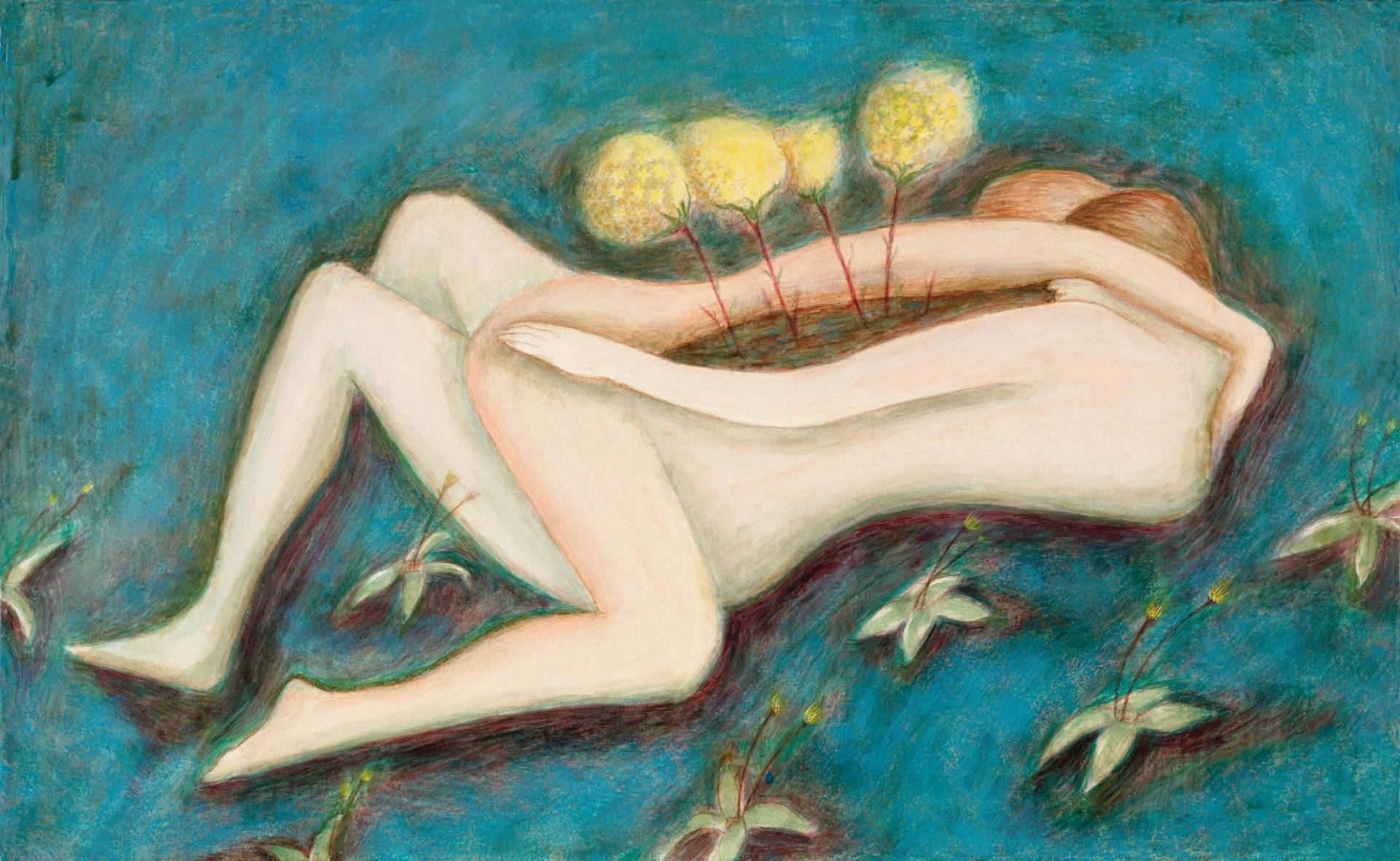
Of all my paintings, perhaps The Blossoming of Love best embodies this elusive aesthetic. But even this gentle painting has shocked some viewers. The painting expresses the delight and fertile creativity that a synergistic love relationship can bring. I see my portrayals of sex as neither pornography nor erotica but as genre painting depicting scenes from everyday life like planting flowers or reading a book.
That said, some of my paintings are explicitly sexual because I don’t like censoring myself, but even in those I try to bring out the emotional aspect of intimacy. When Degas, Courbet, and others portrayed women in their baths, it was at first considered scandalous, but now it is commonplace, even boring.
Your subject matter is very bodily but the egg tempera process you use to create your paintings is rooted in painting traditions that have existed for thousands of years, sometimes associated with religious iconography. What do you like about that combination?
Egg tempera was extensively used by icon painters of the Byzantine Empire, but its roots go even further back to pagan cultures, specifically the Mycenaean Greeks and Greek artists living in what is now Turkey and Egypt. Prior to panel painting, egg was used on dry plaster walls (secco) rather than wet plaster (fresco).
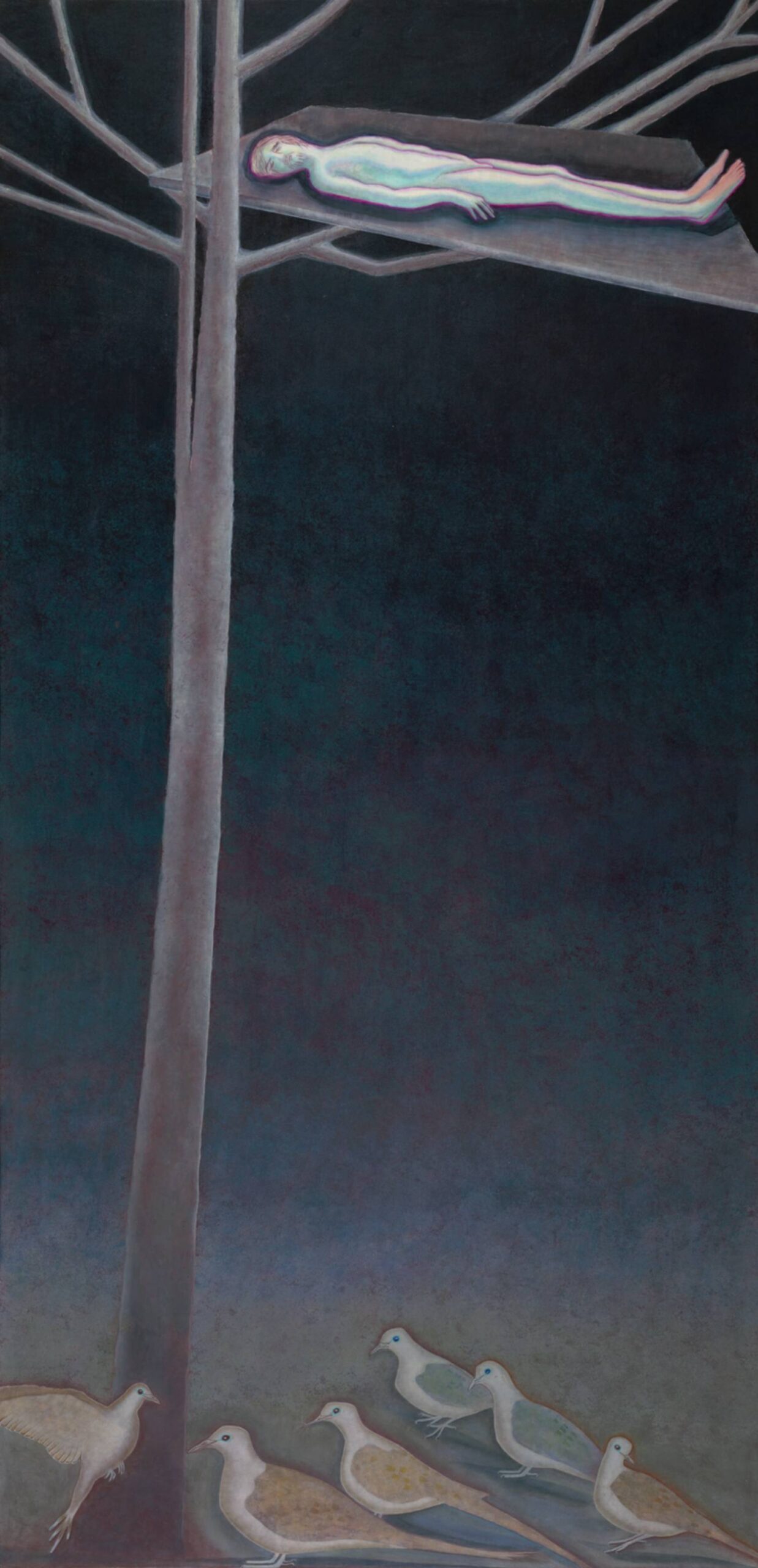
My interest in the history of egg tempera led me to read about early Christianity and preachers such as St. Francis of Assisi. I even went to Assisi to view Giotto’s fresco, St. Francis Preaching to the Birds, which was the reference image for the doves in my painting, Birds of Pray.
So perhaps it was this connection with sacred art that steered me towards seeking the spiritual within what is considered profane or taboo. Interestingly, the word taboo itself, in its Polynesian origin, meant sacred as much as forbidden.
I attempt to infuse my art with a sense of the transcendent. And perhaps naively, I believe egg tempera itself has the power to sanctify seemingly profane imagery.
Why do you think Americans in particular are so averse to engaging with material that speaks to our bodily functions or death?
Perhaps it is the Puritan roots of the United States that set the tone. The Native Americans who preceded them had a very different relationship to the body and to death, but that culture was largely wiped out. Although I consider myself “sex-positive,” there is a line when openness about sexuality can bleed into exploitation and violence towards women. That makes me want to climb back into a protected private place.
I think Americans’ relationship with death has many factors. Since the mid-twentieth century, most Americans have died in hospitals, and many have never seen a dead body. Hospice is only beginning to change that.
Of course, this is different for nurses. I remember witnessing my first death in nursing school. One minute the patient was alive, although very old and uncomfortable, the next moment he was dead. My mentor came into the room and said, “We must wrap up the body.” But first we brought the family in to say goodbye. They were crying. It seemed very natural but still tragic.
The youth and optimism cult in America is averse to death, as is the medical community, which is focused on cure, death being seen as failure rather than a natural finale of life. And finally, the Puritans, again, viewed death as a terrifying Judgment Day.
This is now changing with medical aid in dying authorized in 13 states plus Washington, D.C.
Has your relationship with these subjects changed over time as you’ve worked as a nurse and created as an artist?
It’s changed only in the sense that I hate being bored so I don’t like repeating the same subject matter. However, a few years ago I painted a small preparatory study that took a year to complete and looks like a finished painting rather than a practice piece.
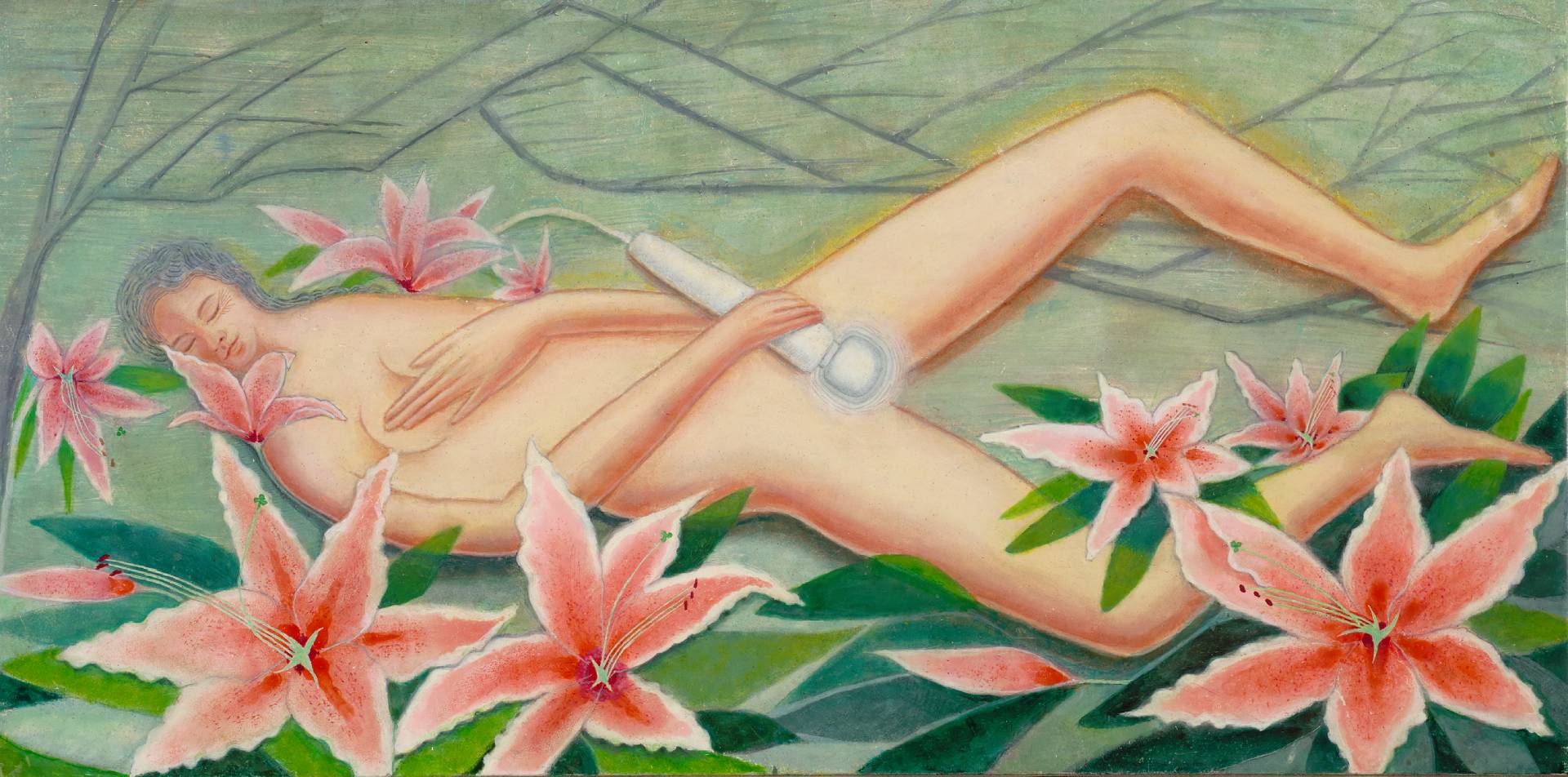
But my original intention was to blow the figure up bigger than life-size. I’m now working on the huge painting, and although similar to the preparatory study, it’s quite different. I feel challenged and gratified working on it. The title of this painting is Fish Without Bicycle, which comes from the feminist saying “A woman needs a man like a fish needs a bicycle.” The slogan was popularized by Gloria Steinem, who died this September, but it was actually coined by the Australian writer Irina Dunn.
The concept that a woman does not need a man to experience pleasure was promoted by Betty Dodson, a sex educator who pioneered the sex-positive feminist movement. Dodson was still conducting workshops at the age of ninety-one, teaching women how to achieve orgasm. She died in 2020.
Traditionally, her workshops featured the Hitachi Magic Wand, the vibrator pictured in the painting. The composition is a celebration of sensuality, featuring fragrant lilies in a lush setting. The woman’s gray hair and the leafless branches are references to sexuality in older women.
Whereas my earlier paintings often describe a friend, patient or imaginary human, Fish Without Bicycle, although not a self-portrait, speaks to where I am in my life now as an older woman still appreciating sensuality.
As a registered nurse, do your experiences seep into the paintings or do you try to keep them separate?
My current role as care manager is primarily a desk job and hasn’t appeared in any artwork. The experiences that most seeped into paintings were my work with AIDS patients during the epidemic. But also my friends and colleagues who died. I think it’s not always the actual nursing work but the medical lens through which I see the world. Two of my paintings, a category I call “surgical surrealism,” are based on stories a female surgeon told me.
In your memoir, you write about how slow the painting process for you can be. Do you think the amount of time it takes to create a painting opens up possibilities to discover something new about the painting while you work or do you wish it went faster? How do you approach slowness in general? Do you think it’s a quality we’re losing that we should embrace more, particularly in art-making?
I resist and bemoan the slowness of my art process. One of my paintings took seven years to complete! I could romanticize the benefits of slowness promoted by movements like Slow Food. But to be honest, half or more of my slowness is simply garden-variety procrastination and its virulent cousin “art avoidance.”
Just this week I spent several days struggling to paint the bud of a lily flower so that it harmonized with my painting without clashing with the other elements. I made numerous color sketches without satisfaction. I expressed my frustration to my non-artist boyfriend and voilà! the solution came to me: the bud needed to be green, not pink. Sometimes when I find myself avoiding art, I meditate or write in my journal to figure out my next step.
I would like to produce more paintings, but not at the expense of deep exploration of a subject. It’s not unusual for an author to spend years writing just one novel. So perhaps I am not a slow painter, this is just how long painting takes for me. The times when I adopt this mindset, I can surrender to the slow pace.
Where do you find inspiration currently?
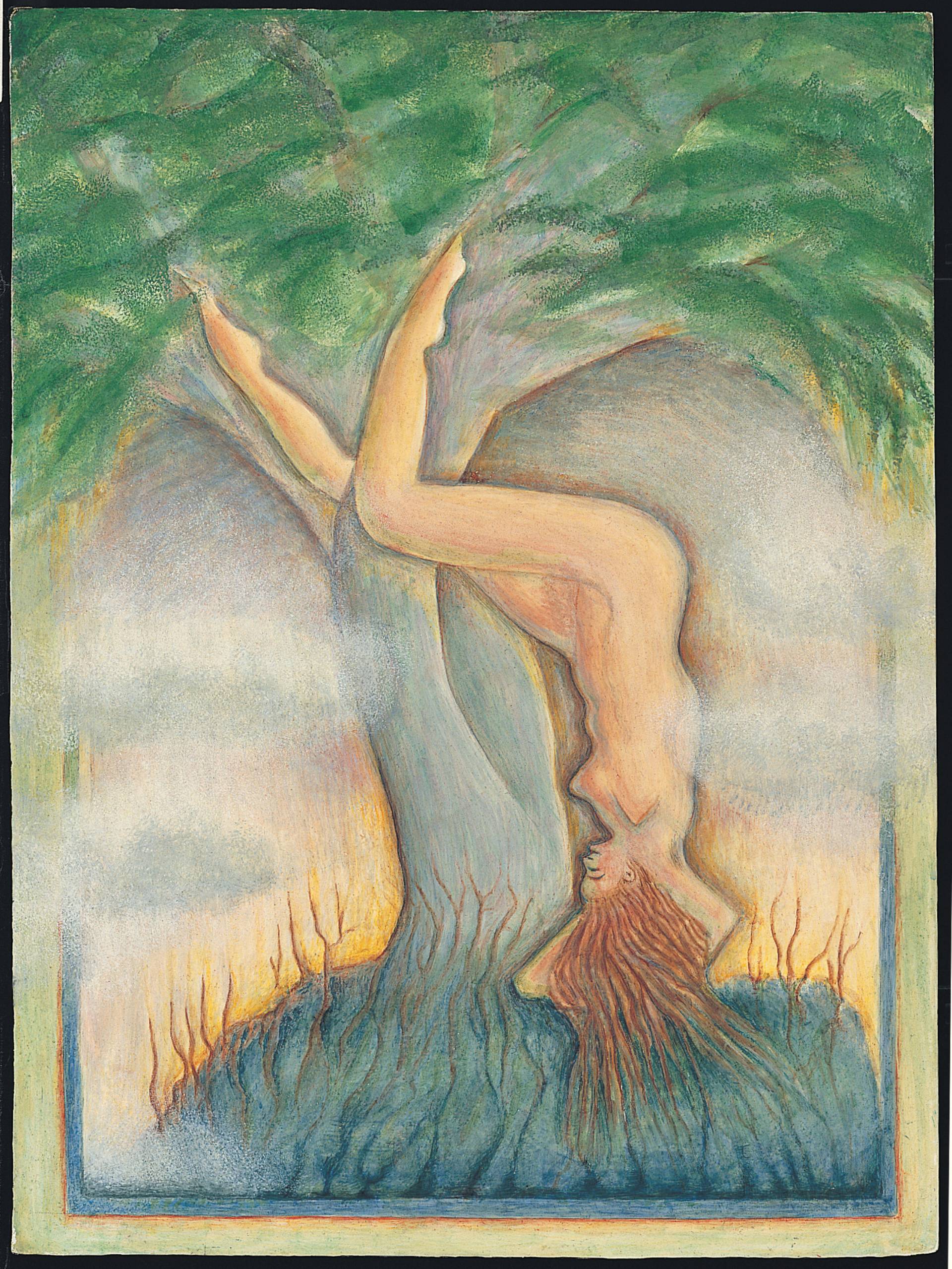
I always find trees inspiring, especially the bark. Trees appear in four of my paintings. Just today I saw a weeping willow and tried to imagine a context to put it in. Nothing came to mind, but I added it to my list of painting ideas.
There is a kind of fir tree, the balsam fir, that has blisters on its bark. I’ve always wanted to paint a person with blisters next to a tree with blisters. This image has been rattling around in my mind for years, but the idea lacks enough of a story to entice me to move forward.
Sometimes inspiration comes from an idea I already have. Years ago, in nursing school, I was invited to the wedding of two people with disabilities. I’ve been making sketches of this wedding scene on and off ever since. Set in a luxuriant garden, a disabled couple approaches the officiant, one in a wheelchair, the other with a walker. The actual wedding I witnessed took place in a drab church.
Recently, after reading The Braille Encyclopedia by Naomi Cohn, it occurred to me that the officiant should also be disabled. That sent me researching braille and how to represent it in a painting. My sketches now show the officiant’s fingers on the bumps of braille, reading her ceremony notes.
What are you currently working on?
In addition to the wedding scene, another elaborate painting has been percolating in my mind for years: the moment of farewell as my grandmother emigrated from Poland to the US in 1928.
My mother told the story of her mother (my grandmother Hannah) ripping open her mother’s dress to kiss her heart, because she knew she would never see her again. In those days, people did not fly back and forth for visits. And indeed she never saw her mother again. Her mother died of asthma a few years later.
Four of Hannah’s six siblings emigrated. The other two were murdered by the Nazis. I am named after one of those great aunts. Immense gratitude floods me for the sacrifices my ancestors made that have brought me to this creative life.
Also, I’m working on a painting about immigration keeps me in touch with the horrific anti-immigration policies currently practiced in the US.
But a painting needs more than a good story and a good composition. It needs to bring together concept, visual brilliance, and emotion for me to invest the time and angst required to manifest the vision. In this painting, I see the buttons on her dress flying out of the picture plane and the feathers from the down comforters being packed for the voyage, sailing through the air. A few mangy chickens are scratching on the ground, the source of the down.
Another challenge is that the painting is asking to be 8 by 16 feet (about 2.4 by 4.9 meters), which is enormous for egg tempera. I’m not superstitious, but I usually don’t talk about future paintings in such detail. But it seems that sharing this vision keeps it top of mind and fortifies my desire to bring the painting to life.